

How AI Is Reshaping Legal Practice and the Business of Law
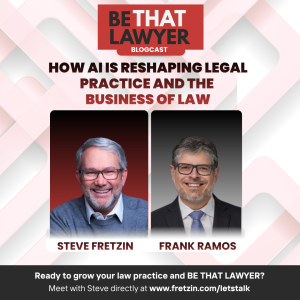
AI Is Changing More Than Legal Work. It Is Changing the Business of Being a Lawyer
By Steve Fretzin and Frank Ramos
AI may make legal work faster, but its bigger impact could be on how lawyers build their brands, find clients, manage their time, price their services, and create careers that remain valuable.
Most conversations about artificial intelligence and the legal profession seem to begin in the same place. Can AI review documents? Can it summarize a deposition? Can it draft a motion? Will it replace associates? Will it hallucinate a case and get somebody sanctioned?
Those are important questions, but they are not the questions that interest me most.
I have been coaching lawyers on business development for nearly two decades, and one of the biggest changes I have made in the last few years is spending significantly more time helping lawyers think about marketing and personal branding. Business development is still the foundation, but we are living in an attention economy. Lawyers increasingly need relationships and visibility working together.
That is why my latest conversation with Frank Ramos was so interesting. Frank is a veteran litigator, prolific writer, speaker, and one of the heaviest AI users I know in the legal profession. Rather than focusing exclusively on how AI can make legal work faster, we explored how lawyers can use it to think differently about their careers, businesses, marketing, productivity, and value.
Frank opened with a Peter Drucker quote: “The best way to predict the future is to create it.”
That may be one of the most useful ways for lawyers to think about AI right now. You do not need to know exactly what the legal profession will look like five years from now. You need to understand enough about what is changing to begin creating your place in it.
Start by Asking AI What the Market Already Sees
Frank offered a simple starting point for lawyers who have barely experimented with AI: ask it about yourself.
Tell the platform your name, your firm, what you do, and what you want to accomplish. Then ask it to evaluate your online footprint and explain how the outside world might perceive you based on what is publicly available.
That can be an interesting exercise because the answer may be very different from how you think you are positioned.
You may believe you are known as a sophisticated employment lawyer for middle market companies, while your online footprint barely communicates that. You may think your website, LinkedIn profile, articles, speaking engagements, and other content clearly establish your niche, yet an AI model looking across that information may find your positioning confusing or generic.
From there, the conversation can become more strategic. Frank described asking AI who his target audiences are, what organizations they belong to, what publications they read, where they spend time, and where the points of overlap might exist between him and the people he wants to reach.
That is where AI becomes more interesting to me as a business development coach. It is not replacing strategy. It is giving lawyers another tool for developing and pressure testing strategy.
If you know the clients you want but do not know where to find them, AI can help you research that. If you know where they are but do not know what content might resonate with them, it can help you think through that. If you have several possible business development routes and limited time, it can help you compare them.
The lawyer still has to make the decisions and build the relationships. AI can help make those decisions more informed.
Your Marketing Should Follow Your Audience
One point Frank made that lawyers should pay attention to is that different audiences require different approaches.
A personal injury attorney trying to reach consumers may find opportunities through Instagram, TikTok, or video. A lawyer representing sophisticated corporations may spend considerably more time on LinkedIn, industry publications, conferences, and professional associations.
AI can help lawyers work backward from the audience rather than starting with the marketing tactic.
Instead of asking, “Should I be on LinkedIn?” ask, “Where are the people I most want to meet, what information do they care about, and how can I become more visible and valuable in those places?”
That distinction matters.
Lawyers regularly tell me they feel pressure to post on social media, create videos, write articles, start podcasts, send newsletters, attend conferences, network, speak, and somehow continue practicing law at the same time. Trying to do everything is a recipe for doing most of it poorly.
The better strategy is identifying the channels where your ideal clients and strategic partners are most likely to pay attention and becoming consistently visible there.
AI can make the research, planning, drafting, and repurposing much easier. But the strategy still begins with understanding who you want to reach.
AI Can Turn a Generic Presentation Into a Business Development Tool
Frank and I spent time talking about presentations because this is an area where AI can potentially save an enormous amount of time.
He explained that presentations that once took him most of a day can now be developed much faster with AI assistance, while also becoming more visually compelling and tailored to the audience. More importantly, he emphasized using information about the organization or conference to customize the presentation instead of simply delivering the same generic deck everywhere.
That last point is the business development opportunity.
Imagine you are presenting to an association of healthcare executives. Instead of showing up with the same deck you used for manufacturers six months earlier, you can provide AI with background about the organization, its audience, its industry, its priorities, and your existing presentation. Then ask it to help identify where the examples, visuals, language, or emphasis should change.
The result should feel like you created the program for the people sitting in front of you.
That makes a difference.
Speaking is not merely an educational exercise. It is an opportunity to demonstrate expertise, relevance, preparation, and understanding. When people feel like you understand their world, you become much more memorable than the speaker who simply changes the title slide and delivers the same presentation everywhere.
Your Inbox Shouldn’t Be Your Full-Time Job
Another practical application we discussed was email.
Frank receives an extraordinary volume of incoming communication across email, LinkedIn, text messages, voicemail, and other platforms. Without systems to manage that volume, communication itself can consume the entire workday. He described using Microsoft Copilot with Outlook to help manage messages and create efficiencies around repetitive communication.
This resonated with me because I have the same issue in a different context. I regularly receive inquiries from people and agencies wanting to place guests on the BE THAT LAWYER podcast. I appreciate the interest, but I do not need to personally rewrite essentially the same response 10 or 20 times a week.
That is exactly the kind of repetitive work lawyers should be examining.
How many times are you typing a nearly identical email? How much time are you spending scheduling? How many routine communications could be templated, automated, drafted, categorized, or handled by someone else?
Saving three minutes does not sound important. Saving three minutes 20 times a week starts becoming meaningful. Multiply that across email, scheduling, intake, follow-up, meeting preparation, document handling, and other recurring activities, and you can potentially reclaim hours.
The important question then becomes what you do with those hours. For lawyers trying to build a book of business, reclaimed time can become networking, client development, strategic partner meetings, content creation, or simply enough breathing room to stop treating business development as the thing you will eventually get to when everything else is done.
AI Agents Sound More Complicated Than They Are
We also talked about AI agents, a term that is thrown around constantly but still confuses a lot of people.
Frank’s explanation was refreshingly simple. An agent is essentially a multi-step instruction that a platform follows to accomplish a recurring task. You might instruct it to review incoming emails at a particular time, categorize them, respond to certain categories, flag others, and move irrelevant messages elsewhere.
That does not mean every lawyer should immediately build dozens of agents.
Testing matters.
I shared that I have experimented with trying to create email automation through general AI tools and have not always found the experience as intuitive or reliable as using software specifically built for that purpose. Frank agreed that this is an important distinction.
Just because you can build something yourself does not mean you should.
There are times when spending hours building, testing, troubleshooting, and maintaining your own workflow makes sense. There are other times when paying $50 a month for software that already solves the problem is the smarter decision.
Lawyers should think about AI the same way they think about delegation. Consider the value of your time, the importance of the problem, the reliability required, and whether building the solution yourself is actually the highest and best use of your time.
AI Requires Experimentation, Not One Perfect Prompt
One reason lawyers become frustrated with AI is that they expect it to work perfectly after a few instructions.
When it does not, they conclude that either the technology does not work or they are doing something wrong.
Frank described spending hundreds of hours experimenting with some of the AI projects he is developing. That is obviously far beyond what most practicing lawyers will want to invest, but his larger point matters: effective use often involves trial and error.
You prompt. You review. You correct. You provide better context. You test again.
Over time, you learn what the technology does well, what it does poorly, and where another tool may be more appropriate.
This is not very different from learning business development. You do not attend one networking event, fail to get a client, and conclude that networking does not work. You improve your questions, follow-up, positioning, targeting, and consistency.
AI requires some of that same patience.
The question is not whether you become an AI expert. The question is whether you become competent enough to understand where these tools can create leverage in your practice.
Confidentiality Has to Come Before Convenience
The conversation became much more serious when we moved from marketing and productivity into client information.
Frank emphasized that lawyers need to understand what happens to the information they put into an AI platform. His firm uses systems that have been vetted to protect sensitive information, and he stressed the importance of working with IT professionals and appropriate internal resources to understand how data is stored, processed, used, and potentially exposed.
This is an area where “I think it’s probably fine” is not a sufficient standard.
Before lawyers put confidential client information, medical records, deposition transcripts, strategy documents, or other sensitive materials into an AI system, they need to understand the platform and their professional obligations.
Convenience cannot outrank confidentiality.
There is also a second issue: accuracy.
AI may be excellent at summarizing documents, depositions, medical records, or other large amounts of information, but Frank was clear that someone still needs to compare the output against the underlying material.
Human oversight is not optional simply because the output looks polished.
A confident answer can still be wrong.
Your Clients’ AI Use May Create Risks Too
One of the most interesting parts of our conversation was something lawyers may not be thinking about enough: what are your clients doing with AI?
A lawyer may carefully protect confidential information while the client takes an email, strategy memo, draft agreement, or other communication and uploads it into a consumer AI platform because they want a second opinion.
Frank raised concerns about how that behavior could potentially affect confidentiality or privilege depending on the circumstances, and suggested that lawyers should consider proactively discussing AI use with clients rather than assuming clients understand the risks.
That conversation could become increasingly important.
Clients are curious. They want to save money. They want to understand what their lawyer sent them. They may naturally think, “I’ll just put this into AI and ask what it means.”
Instead of simply telling clients not to do something, explain why.
Lawyers may also want to consider how their engagement letters, client communications, and information security practices address third-party AI tools. The specific ethical and privilege implications can vary by jurisdiction and circumstances, so firms should develop policies with appropriate legal, ethics, privacy, and technology guidance.
The bigger lesson is that AI governance cannot stop at the law firm’s front door.
AI Could Force Lawyers to Rethink the Billable Hour
Frank made one of his boldest predictions when we discussed how AI may affect law firm economics.
He believes many hourly practices will increasingly move toward flat-fee arrangements because AI can dramatically reduce the time required to perform certain tasks. If work that once required several hours of associate or paralegal time can be completed much faster, clients are unlikely to ignore that forever.
Whether the shift happens as quickly or broadly as Frank predicts remains to be seen, but the underlying issue is difficult to ignore.
AI creates tension between efficiency and hourly billing.
For decades, efficiency has created an unusual economic problem for law firms. If a lawyer becomes twice as efficient and charges strictly by the hour, the firm may produce the same outcome while billing less. AI could accelerate that problem dramatically.
That makes value increasingly important.
What is the client actually buying? Is it six hours of lawyer time, or is it the successful resolution of a problem? Is it a 12-page document, or is it reduced risk? Is it 30 hours of research, or is it the judgment that comes from decades of experience?
Law firms that begin thinking about those questions now will be better prepared if clients increasingly demand pricing models that reflect outcomes and value rather than time alone.
What Happens to the Work AI Can Do?
The most uncomfortable part of our conversation involved jobs.
Frank believes AI will reduce the need for some roles that historically performed repetitive legal work, particularly certain paralegal, legal assistant, and junior lawyer functions. He compared the potential change to what has already happened with legal assistants, where technology allowed fewer support professionals to serve more attorneys.
His specific predictions about the percentage of jobs affected are just that, predictions. Nobody knows exactly how quickly the legal labor market will change or how firms will redeploy people as technology improves.
But lawyers should pay attention to the direction of the conversation.
If the work you perform can increasingly be automated, summarized, generated, or analyzed by technology, what becomes more valuable?
Judgment.
Relationships.
Client trust.
Leadership.
Strategy.
Creativity.
Communication.
Business development.
The ability to understand a client’s problem in a way that extends beyond the legal issue.
That is one of the reasons I have spent my career telling lawyers that developing a book of business creates professional independence. AI only makes that message more relevant.
Being excellent at legal work will always matter. But if technology makes portions of that work easier to produce, lawyers who can also generate relationships, opportunities, trust, and revenue become even more difficult to replace.
AI Makes Personal Branding More Important, Not Less
There is an interesting paradox developing.
AI is making it easier than ever to create content. That means the world is about to get flooded with even more articles, posts, videos, newsletters, presentations, and generic thought leadership.
So why bother creating anything?
Because the objective is not simply to create more content.
It is to become recognizable for something.
Frank has spent years writing, speaking, mentoring younger lawyers, participating in professional organizations, and developing his reputation. AI can help him produce and repurpose ideas more efficiently, but the technology did not create the underlying expertise or relationships.
The same applies to lawyers beginning today.
AI can help you organize an article. It can help develop ideas for a presentation. It can help turn a longer piece into LinkedIn content. It can research an audience, brainstorm questions, and improve a headline.
But your experiences, judgment, stories, opinions, relationships, and credibility are still yours.
The lawyers who win the attention game will not necessarily be the ones producing the most AI-generated content. They will be the ones using technology to communicate authentic expertise more consistently and effectively.
Frank’s Biggest Mistake Had Nothing to Do With Technology
At the end of the episode, I asked Frank about his biggest mistake.
His answer was that he did not bet on himself early enough.
Frank has become a prolific writer and speaker, but public speaking once terrified him. For years, he assumed that fear meant he was not good at it. Eventually, he realized there is an important difference between lacking a skill and being afraid to try something.
That distinction applies to almost every lawyer I coach.
“I am not good at networking.”
“I can’t post on LinkedIn.”
“I am not a salesperson.”
“I could never speak in front of a room.”
“I don’t understand AI.”
Maybe.
Or maybe you simply have not put in enough reps yet.
Frank’s advice was to separate genuine weaknesses from fear. If you truly do not have a skill, you can decide whether to develop it, delegate it, or focus somewhere else. But if fear is the only thing holding you back, the solution is usually action.
Try it. Practice. Get uncomfortable. Learn. Repeat.
Frank made another observation that I loved: we tend to believe everyone is watching us, judging what we do, when in reality most people are busy thinking about themselves. That can be incredibly liberating.
Your first LinkedIn post probably will not be perfect.
Your first presentation probably will not be your best.
Your first attempt at using AI may be terrible.
Do it anyway.
The Future Belongs to Lawyers Who Learn How to Adapt
Nobody can tell you exactly what AI will do to the legal profession over the next five or ten years.
Pricing may change. Staffing models may change. Client expectations almost certainly will. Some tasks will disappear while entirely new roles and opportunities emerge.
But waiting until everything becomes clear is probably the riskiest strategy.
You do not need to become an AI engineer. You do not need 50 new tools. You do not need to automate every process in your firm.
Start smaller.
Use AI to understand your market. Research your ideal clients. Improve a presentation. Create a better business development plan. Identify repetitive tasks. Experiment with an email workflow. Repurpose something you have already written. Ask it to critique your LinkedIn positioning. Learn what your firm’s approved technology can and cannot safely do.
Then keep the human being in the loop.
Technology should create more room for the things lawyers uniquely bring to the table: judgment, relationships, empathy, creativity, strategic thinking, trust, and the ability to help another human being navigate a difficult problem.
AI may change how legal work gets done.
The bigger opportunity is using it to become a better lawyer, business developer, and professional before everyone else figures that out.
Key Takeaways
- AI can help lawyers evaluate how they are positioned online and identify gaps between how they want to be known and what their digital footprint actually communicates.
- Start marketing strategy with the target audience, then determine which platforms, organizations, publications, and content formats are most likely to reach them.
- AI can help lawyers customize presentations to particular industries and audiences rather than recycling generic slide decks.
- Repetitive email, scheduling, intake, and communication tasks are strong candidates for automation, but specialized software may sometimes be more practical than building your own AI workflow.
- AI agents can automate multi-step tasks, but they need clear instructions, testing, and ongoing oversight.
- Confidential client information should only be used with appropriately vetted platforms and safeguards consistent with the lawyer’s professional obligations.
- AI-generated summaries and legal work still require human review against the original source material.
- Lawyers should consider discussing AI use with clients because clients themselves may upload privileged or sensitive information into third-party tools.
- AI-driven efficiency could increase pressure on traditional hourly billing and make value-based or alternative fee arrangements more relevant.
- As repetitive legal tasks become easier to automate, judgment, relationships, leadership, strategy, communication, and business development may become increasingly important differentiators.
- Lawyers should distinguish between a genuine skill gap and fear. Many professional abilities improve through practice and repetition.
A Quote to Remember
“With AI, we all have this tool now that can help direct our careers and our professions, and beyond the obvious ways.” — Frank Ramos
Frequently Asked Questions About AI and the Legal Profession
How can lawyers use AI for business development?
Lawyers can use AI to research target markets, evaluate their online presence, identify organizations and publications relevant to ideal clients, develop business development plans, prepare for meetings, brainstorm content, improve presentations, and repurpose existing thought leadership.
Can AI help lawyers improve their personal brands?
Yes. AI can help analyze how a lawyer appears online, identify gaps in positioning, develop content themes, improve LinkedIn posts, tailor messaging to specific audiences, and create a more consistent visibility strategy. The lawyer’s own expertise and perspective should remain at the center of the content.
How can lawyers use AI to improve presentations?
Lawyers can provide AI with an existing presentation plus information about the organization, industry, event, and audience. The technology can then help identify ways to reorganize the material, customize examples, improve visuals, simplify slides, and make the presentation more relevant to the people attending.
What is an AI agent?
An AI agent can be thought of as a system that follows a set of instructions or steps to complete a recurring task. Depending on the platform and permissions, agents may help categorize information, prepare responses, monitor workflows, or automate repetitive processes. They should be tested carefully before lawyers rely on them.
Should lawyers build their own AI automations or buy specialized software?
It depends on the complexity of the problem, the lawyer’s technical ability, the reliability required, and the value of the lawyer’s time. If a specialized product solves an important problem reliably for a reasonable monthly fee, buying it may make more economic sense than spending many hours building and maintaining your own solution.
Can lawyers put confidential client information into AI tools?
Lawyers need to understand the platform, its data practices, applicable professional obligations, and their firm’s security policies before entering confidential information. Sensitive information should not simply be placed into a consumer AI tool without appropriate vetting and safeguards.
Does AI-generated legal work still need human review?
Yes. Frank emphasized that someone needs to compare AI output with the underlying material. A deposition summary should be checked against the deposition, for example, rather than being accepted simply because the output appears professional and complete.
Should lawyers be concerned about clients using AI?
Potentially. Clients may upload legal advice, drafts, confidential communications, or other sensitive information into third-party AI platforms without understanding the possible consequences. Lawyers should consider discussing appropriate AI use and confidentiality with clients.
Will AI eliminate the billable hour?
That is not established, but Frank predicts significant movement toward flat-fee arrangements as AI reduces the time required for certain legal tasks. At a minimum, increased efficiency may put more pressure on firms to explain how their pricing reflects the value clients receive rather than simply the number of hours required.
Will AI replace lawyers and paralegals?
The long-term employment impact remains uncertain. Frank predicts substantial reductions in some repetitive support and junior legal roles, while other observers expect many jobs to evolve rather than disappear. What is clearer is that professionals whose value depends heavily on repetitive tasks will need to adapt as AI becomes more capable.
What skills may become more valuable as AI improves?
Judgment, strategic thinking, relationships, trust, leadership, communication, creativity, client understanding, and business development are all areas where lawyers can create value beyond simply producing legal work more efficiently.
What is a good first AI exercise for a lawyer?
Ask an approved AI tool to evaluate your professional positioning. Provide your name, firm, practice area, goals, and target clients, then ask what your current online footprint communicates, where your ideal audience can be found, and what gaps may exist between your goals and your current visibility.
Continue Learning with BE THAT LAWYER
Check out BE THAT LAWYER Coaches Corner, where I share the strategies I use with my clients to win more business, improve their productivity, strengthen their brands, and love their careers again.
Join the BE THAT LAWYER Community
Join the BE THAT LAWYER Community and connect with ambitious lawyers who are serious about growing their books of business, strengthening their brands, exchanging ideas and referrals, and becoming confident, consistent rainmakers.
https://BETHATLAWYER.com/community/
Go From Good to GOAT with PIMCON
Ready to go from good to GOAT in your legal marketing game? Don’t miss PIMCON, where some of the brightest minds in professional services gather to share what is actually working.
Thank You to Our Sponsors
LEX Reception: https://www.lexreception.com/partners/bethatlawyer
Rankings.io: https://rankings.io/
Lawyer.com: https://www.lawyer.com/
Ready to Grow Your Law Practice?
AI can make you faster, but technology alone will not build your book of business. If you want a clearer strategy for developing relationships, strengthening your personal brand, and creating a repeatable business development process without selling or chasing, book your free 30 minute strategy session.
About Frank Ramos
Frank Ramos is a nationally recognized litigator, strategic advisor, author, speaker, and thought leader with nearly three decades of legal experience. His practice includes commercial, product liability, premises liability, trucking, personal injury defense, and insurance disputes.
Frank has been named Miami’s Product Liability Lawyer of the Year twice by The Best Lawyers in America and holds an AV Preeminent rating from Martindale-Hubbell. In addition to his legal practice, he advises businesses and legal professionals on artificial intelligence, professional development, and the changing practice of law.
Known as the “Miami Mentor,” Frank has written 20 books and more than 500 articles on trial practice, attorney development, litigation management, and related topics. He also writes a weekly column for Above the Law focused on practical guidance for younger lawyers.
Connect with Frank Ramos
Website: https://www.goldbergsegalla.com/our-team/frank-ramos/
LinkedIn: https://www.linkedin.com/in/miamimentor/
Connect with Steve Fretzin
LinkedIn: https://www.linkedin.com/in/stevefretzin/
Twitter: https://twitter.com/stevefretzin
Instagram: https://www.instagram.com/fretzinsteve/
Facebook: https://www.facebook.com/fretzinsteve
Website: https://BETHATLAWYER.com/
Email: [email protected]
Books: https://www.BETHATLAWYER.com/about/books/
YouTube: https://www.youtube.com/user/SalesResultsInc
Call Steve directly: 847-602-6911
Audio production by Turnkey Podcast Productions. You’re the expert. Your podcast will prove it.
Grow Your Practice
Fill out the form below and we’ll be in touch