

Why CEOs Need Peer Advisory Circles to Truly Lead
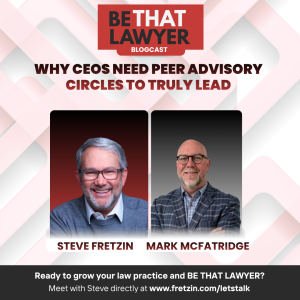
Why CEOs Need Peer Advisory Circles to Truly Lead
By Steve Fretzin and Mark McFatridge
Leadership can look very different from the outside than it feels on the inside. A CEO may appear successful, confident, and in control while privately dealing with difficult decisions, family responsibilities, health concerns, or the pressure of leading an organization through uncertainty.
In this episode of BE THAT LAWYER, Mark McFatridge explains why many of the biggest challenges facing CEOs are not strictly business problems. They are life problems that inevitably affect the business. He also shares how confidential peer advisory circles can give leaders the perspective, accountability, and support they need to make better decisions and lead more effectively.
For lawyers and other professionals, the conversation offers an important reminder: becoming a trusted advisor is not about having every answer. It is about listening deeply, understanding the real problem, and helping people find the right path forward.
The Difference Between Listening and Truly Understanding
One of the most important leadership and business development skills is the ability to listen to understand rather than listening to reply.
Many professionals listen while preparing their next statement, planning how to respond, or looking for an opportunity to explain their own expertise. That approach can cause them to miss what the other person is actually saying.
Deep listening requires patience and curiosity. Instead of immediately offering a solution, trusted advisors ask better questions and create space for the other person to explain what is really happening.
This is especially important when working with CEOs. The problem they initially describe may not be the problem they actually need to solve. A business concern may be connected to stress at home, uncertainty about the future, a difficult employee relationship, or a personal transition.
The better a professional listens, the more likely they are to uncover the real issue and provide meaningful value.
From Banking to CEO Peer Advisory Groups
Mark’s path to founding Quade Executive Peer Group was shaped by more than 25 years of professional experience. He has served as a CEO and board member for both publicly traded and privately held companies, including extensive experience in community banking.
As an organizational turnaround specialist, Mark has helped underperforming businesses improve their performance and scale. In one notable example, he guided the exit of a private company that increased in value by 800% within three years of his taking over as CEO.
His experience also gave him a firsthand understanding of the isolation that can come with leadership. Even when CEOs have talented employees, professional advisors, and strong networks, they may not have a confidential environment where they can openly discuss the decisions and challenges they face.
That realization led Mark to build peer groups designed to help CEOs learn from one another and make better decisions through shared experience.
Many CEO Problems Are Really Life Problems
Business leaders often assume they should be able to solve every challenge through strategy, discipline, or hard work. But personal circumstances can have a major impact on professional performance.
Family responsibilities, health issues, aging parents, relationship challenges, and major life transitions can all affect a CEO’s ability to focus and lead. These issues do not disappear when someone walks into the office. They become part of the reality that leader must manage.
Mark explains that peer advisory circles give CEOs a place to discuss these challenges honestly. Members can share experiences with people who understand the pressure of leadership and can offer perspective without judgment.
Sometimes the most valuable insight does not come from someone with the same industry background. It comes from another leader who has faced a similar personal or professional situation and can help the group member see new options.
The Power of Confidential Peer Advisory Circles
A strong peer advisory group is more than a networking organization. It is a structured environment where leaders can be vulnerable, receive honest feedback, and work through important decisions.
Confidentiality is essential. CEOs need to know that they can discuss sensitive business and personal matters without worrying that the information will be shared outside the group.
The structure of the group also matters. Productive circles are not simply informal conversations where everyone offers opinions. They create a process for presenting challenges, asking questions, considering different perspectives, and identifying specific next steps.
The group becomes especially valuable when members are willing to challenge one another respectfully. A trusted peer may notice a blind spot, question an assumption, or offer a perspective that the leader’s internal team is unable to provide.
Over time, members benefit not only from the advice they receive but also from the experiences of everyone else in the room.
Shared Experience Accelerates Growth
One of the most powerful benefits of a peer advisory circle is the ability to learn from other people’s experiences without having to live through every situation personally.
Mark explains that being part of a group allows leaders to accelerate their growth because they effectively gain access to the experiences of their peers. A member may learn from another CEO’s hiring mistake, succession planning process, acquisition, difficult client situation, or personal transition.
That shared experience can help leaders avoid unnecessary mistakes and make decisions with greater confidence.
It also creates a broader perspective. CEOs may become so focused on their own businesses that they lose sight of how other leaders approach similar challenges. Hearing different approaches can help them recognize that there is rarely only one way to solve a problem.
Accountability Turns Decisions into Action
Insight is valuable, but insight alone does not create change. Leaders also need accountability.
Peer advisory circles help members move from discussion to implementation by requiring them to identify specific actions and report back on their progress. This creates a level of commitment that is often missing when someone makes a decision privately.
For example, a CEO may commit to having a difficult conversation, delegating a responsibility, reviewing a financial issue, or creating a plan for a major transition. Knowing that the group will ask about the outcome makes it more likely that the leader will follow through.
Accountability also creates an opportunity to learn from the results. If an action does not produce the expected outcome, the group can help the member evaluate what happened and determine the next step.
Moving from Technician to Trusted Advisor
The conversation also connects directly to business development for lawyers and other professionals. Many experts build their careers around technical knowledge. They become excellent at solving specific problems within their area of practice.
But becoming a trusted advisor requires another level of skill.
Trusted advisors do not immediately push their own services. They listen carefully, diagnose the real problem, and help the client identify the best solution even when that solution involves another professional or falls outside their own services.
This approach may seem counterintuitive from a traditional sales perspective, but it builds credibility and long-term relationships. When people believe that a professional genuinely wants to help them, they are more likely to trust that person with future matters and refer others.
That is the foundation of sales-free selling: creating value through relationships, curiosity, and service rather than pressure.
Leadership Requires Perspective and Support
No CEO has complete visibility into every challenge facing their company or their life. Even highly experienced leaders benefit from having people who can ask difficult questions, provide honest feedback, and remind them that they do not have to solve everything alone.
Peer advisory groups can provide that support while also helping leaders become more intentional about how they operate. The goal is not simply to grow a business. It is to build an organization and a life that are sustainable, values-driven, and aligned with what matters most.
For lawyers, the same principle applies. Strong professional relationships are built when people feel heard, understood, and supported. The more effectively professionals listen and guide others, the more likely they are to become trusted advisors and long-term partners.
Key Takeaways
- Effective business development begins with listening to understand rather than listening to reply.
- Many CEO challenges are connected to personal and family issues, not just business strategy.
- Confidential peer advisory groups help leaders discuss challenges, identify blind spots, and gain honest feedback.
- Shared experiences allow CEOs to accelerate their learning and avoid mistakes.
- Accountability increases the likelihood that leaders will act on the decisions they make.
- Professionals become trusted advisors by diagnosing the real problem and connecting people with the best solution, even when it is outside their own services.
“By being in a group with other CEOs, your experiences get accelerated because you basically get to have their experiences as your own, and that just accelerates everything, whether it’s on the personal side or the business side.” — Mark McFatridge
Continue Learning with BE THAT LAWYER
Check out my new show, BE THAT LAWYER Coaches Corner, and get the strategies I use with my clients to win more business and love your career again.
Join the BE THAT LAWYER Community and connect with ambitious lawyers who are serious about growing their book of business, strengthening their brand, and becoming confident, consistent rainmakers.
Ready to go from good to GOAT in your legal marketing game? Don’t miss PIMCON, where the brightest minds in professional services gather to share what really works. Learn more at PIMCON.
Thank you to our sponsors: LEX Reception, Rankings.io, and Lawyer.com.
Ready to grow your law practice without selling or chasing? Book your free 30-minute strategy session and let’s make this your breakout year.
About Mark McFatridge
Mark McFatridge is the Founder and CEO of Quade Executive Peer Group, an organization dedicated to fostering growth, accountability, and strategic peer community for CEOs and business owners.
With more than 25 years of professional experience, Mark has served as chief executive officer and board member for publicly traded and privately held companies across multiple industries, including community banking. An organizational turnaround specialist, he has helped lead underperforming businesses to scale, including guiding the exit of a private company that increased in value by 800% within three years of his taking over as CEO.
Drawing on his background as a former bank president and peer group member, Mark now leads Quade’s facilitated executive circles, helping leaders build sustainable, values-driven organizations through strategic clarity, operational strength, and peer vulnerability.
Connect with Mark McFatridge
Website: Quade Executive Peer Group
LinkedIn: Mark McFatridge
Connect with Steve Fretzin
LinkedIn: Steve Fretzin
Twitter: @stevefretzin
Instagram: @fretzinsteve
Facebook: Fretzin, Inc.
Website: BETHATLAWYER.com
Email: [email protected]
Book: Legal Business Development Isn’t Rocket Science
YouTube: Steve Fretzin
Call Steve directly: 847-602-6911
Audio production by Turnkey Podcast Productions. You’re the expert. Your podcast will prove it.
Grow Your Practice
Fill out the form below and we’ll be in touch