

High-Performance Habits Lawyers Can Actually Sustain
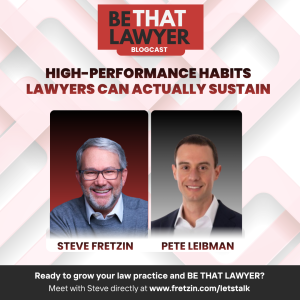
The Lawyer’s Guide to Peak Performance Without Burning Out
By Steve Fretzin and Pete Leibman
How lawyers can protect their energy, sharpen their focus, prepare like elite athletes, and build sustainable habits for long-term performance.
Most lawyers are accustomed to working hard. Long hours, heavy workloads, demanding clients, and constant pressure are often treated as simply part of the profession. But there is a point where working longer stops helping and starts hurting the quality of your performance.
In this episode of BE THAT LAWYER, Steve Fretzin sits down with Pete Leibman, author of Stronger Advisor, to explore what lawyers can learn from elite athletes about sustaining high performance. The conversation goes beyond productivity hacks and focuses on something much more important: how to build the energy, focus, discipline, and habits required to perform at your best over years and decades.
From sleep and nutrition to pregame routines, attention residue, distractions, and habit formation, the discussion offers practical ways for lawyers to stop simply pushing harder and start performing smarter.
The “Work Longer” Myth Is Holding Lawyers Back
One of the biggest myths surrounding high performance is the idea that working longer automatically leads to better results.
In the legal profession, that belief can be especially powerful. The billable-hour model, demanding clients, and heavy workloads can reinforce the idea that being constantly available and putting in more hours is the path to success. But as Pete explains, research has shown that once people move beyond roughly 50 to 60 hours of work per week, the quality of those additional hours can decline significantly.
The problem isn’t simply the number of hours. It’s what lawyers have to sacrifice to create those extra hours. Sleep gets cut. Exercise disappears. Time with family and friends becomes limited. Hobbies and recovery get pushed aside. Eventually, the very activities that help someone perform well at work are sacrificed in the name of working more.
For a profession built around judgment, critical thinking, and decision-making, that can become a serious problem.
Lawyers Need to Treat Their Bodies Like Performance Equipment
Pete’s experience in professional sports and professional services gives him a unique perspective on performance. He grew up playing basketball, worked in professional sports, and later spent years at Heidrick & Struggles, a global executive search and consulting firm where he experienced the long hours and heavy workload that are familiar to many lawyers.
That experience helped shape his thinking around sustainable performance.
Exercise isn’t simply about becoming physically stronger. It can also support mental and psychological performance. Pete points to the research around exercise and the brain, including the work discussed in John Ratey’s book Spark, which explores the mental and psychological benefits of physical activity.
But exercise doesn’t exist in isolation. It needs to be supported by proper recovery, sleep, and nutrition.
The same principle applies to food. What you put into your body can influence your energy, focus, and ability to perform throughout the day. Exercise may be the foundation, but sleep and nutrition help determine whether you’re actually able to recover and benefit from it.
Build a Pregame Routine for Your Legal Career
One of the most useful lessons lawyers can borrow from elite athletes is the idea of a pregame routine.
The world’s greatest athletes don’t simply walk onto the court, field, or rink and expect to perform at their highest level immediately. They have deliberate routines designed to warm up their bodies, sharpen their focus, and get themselves into the right mental state.
Pete uses Stephen Curry as an example. Curry’s meticulous pregame preparation is something fans can actually watch because he arrives early and follows a highly deliberate routine before the game begins.
The important lesson isn’t that lawyers should copy an athlete’s exact routine. It’s that they should create their own.
A lawyer’s pregame ritual might include exercise, meditation, reviewing priorities, preparing mentally for the day, or simply creating uninterrupted time to get focused before the demands of work begin.
Your Pregame Routine Can Also Improve Business Development
Steve adds an important business-development application to the concept.
Before meeting with a prospective client or attending a networking one-on-one, preparation can make a tremendous difference. Steve researches the person, takes notes, thinks about questions he wants to ask, and looks for opportunities to build genuine rapport.
He also uses a one-page “cheat sheet” based on his Sales-Free Selling approach to prepare for meetings. Rather than walking into a conversation focused on pitching, selling, or convincing, the goal is to build a relationship, ask better questions, and determine whether the relationship should move forward.
That’s another example of an athlete-style pregame routine.
The meeting itself is the “game.” The preparation happens beforehand.
Work With a Clean Paintbrush
One of the most memorable concepts Pete shares is the idea of working with a clean paintbrush.
The concept comes from research by business professor Sophie Leroy, who studied what happens when people switch from one task to another. Her research introduced the concept of attention residue, the idea that part of your attention can remain attached to a previous task even after you’ve moved on.
For lawyers, this can become a serious problem.
Imagine spending 30 minutes drafting a legal document, stopping to answer an email, taking a phone call, checking a text, switching to another matter, and then trying to return to the document. Even though you’ve technically moved on, your brain may still be carrying pieces of the previous task.
Pete compares this to painting.
If you dip a paintbrush into one color and then immediately put it into another without cleaning it, the colors begin mixing. Eventually, you end up with a dirty brown paintbrush.
Your attention can work the same way.
If you don’t clean your mental paintbrush between tasks, your attention becomes increasingly scattered. Your thinking gets less clear, errors can increase, stress rises, and the quality of your performance can decline.
Constant Notifications Are Destroying Concentration
Task switching isn’t the only problem. Constant interruptions can be even more damaging.
Pete references research from UC Irvine that found office workers break their concentration roughly every three minutes on average more than 19 times an hour and potentially more than 150 times during a workday.
Whether the interruption comes from an email, text, phone call, notification, or your own decision to jump to another task, the result is fragmented attention.
For lawyers, the consequences can be significant because so much legal work requires sustained concentration.
Pete recommends creating distraction-free periods where your phone is away, email is turned off, and notifications are disabled. During that period, you give the task in front of you your full attention.
Then, after 30, 60, or 90 minutes, you can return to email and other communications.
The goal isn’t to become unresponsive. It’s to stop being constantly interrupted.
Set Expectations Instead of Being Available 24/7
Steve takes that idea one step further by pointing out that lawyers can also manage interruptions by setting expectations.
Responsiveness is important to clients. But responsiveness doesn’t necessarily mean responding within 30 seconds.
Lawyers can establish clear communication expectations for example, letting clients and colleagues know that emails will generally be answered within a certain timeframe or that calls can be routed through an assistant when something is genuinely urgent.
Pete shares an example of a lawyer who has her assistant monitor communications while she works without distractions. If something truly requires immediate attention, the assistant gets her.
That system creates a balance between responsiveness and concentration.
You don’t have to choose between being a good lawyer and doing focused work. You can create systems that allow you to do both.
Don’t Try to Transform Your Entire Life Overnight
For someone who is already overwhelmed, the idea of improving sleep, exercising, eating better, eliminating distractions, and becoming more productive can feel impossible.
Pete’s solution is simple: start with one change.
He calls this a “Stronger Habit of the Month.” Choose one specific behavior you want to start or stop doing and focus your attention on that behavior for approximately a month.
Once it begins to feel automatic, add the next change.
This approach is especially relevant for lawyers because their schedules can be unpredictable. A massive lifestyle transformation may work temporarily, but sustainable improvement comes from habits that can survive busy periods.
One change might not feel revolutionary. But twelve meaningful changes over the course of a year can create a dramatically different routine.
Positive Habits Create a Domino Effect
Steve points out that behavior can influence attitude and belief.
When you start taking positive action whether that’s exercising, improving your diet, sending business-development emails, setting aside time for networking, or following through on a commitment, you can create momentum.
Pete compares this to a row of dominoes.
One positive behavior can make another positive behavior easier. A morning workout may lead to better energy. Better energy may improve productivity. Better productivity may make healthier choices easier. Those improvements can then reinforce one another.
The same thing can happen in the opposite direction.
When negative habits begin stacking up, they can create their own cycle. Avoiding business development for months, failing to follow through on planned activities, or repeatedly allowing distractions to take over can make it harder to regain momentum.
The solution isn’t to fix everything simultaneously. Start by knocking over the first domino.
Make Sleep a Priority Before You Need It
When Pete is asked about his own biggest mistake, his answer isn’t a single dramatic event. It’s a theme: he didn’t prioritize sleep early enough in his career.
When he interviews high performers and asks what they wish they had started doing sooner, sleep is one of the most common answers.
It’s easy to get through a demanding day using coffee, energy drinks, sugar, or sheer willpower. But artificial energy doesn’t replace actual recovery.
For lawyers, sleep deserves particular attention because the profession relies so heavily on mental performance. Getting enough sleep and improving the quality of that sleep can be one of the most foundational changes someone makes.
Sometimes the first step toward becoming a better performer isn’t adding another hour to your workday.
It’s getting to bed earlier.
High Performance Starts With the First Step
The biggest message from this conversation isn’t that lawyers need to completely reinvent themselves.
It’s that high performance is built through intentional behaviors.
You don’t have to change your entire life tomorrow. You don’t need a perfect morning routine. You don’t need to become a professional athlete.
You need to identify what is getting in the way of your performance and take the first step toward changing it.
Whether that first step is protecting your sleep, turning off notifications, preparing before an important meeting, exercising consistently, improving your nutrition, or simply choosing one habit to change, the process begins with action.
As Steve puts it, you can’t run a marathon without taking the first step.
The same principle applies to becoming the best lawyer, business developer, leader, and person you can be.
Key Takeaways
- Working longer doesn’t automatically produce better performance, and excessive hours can reduce the quality of thinking and decision-making.
- Sleep, exercise, nutrition, and recovery are foundational for lawyers whose careers depend on cognitive performance.
- Elite athletes use deliberate pregame routines to prepare their bodies and minds, and lawyers can create personalized routines for their own work.
- Business-development activities can benefit from the same preparation, including researching contacts, preparing questions, and reviewing a relationship-focused framework.
- Attention residue makes frequent task switching especially problematic for knowledge workers.
- Constant notifications can fragment concentration, increase stress, and interfere with high-quality work.
- Lawyers can protect their focus by creating distraction-free periods and setting clearer expectations around responsiveness.
- Sustainable improvement comes from changing one habit at a time rather than attempting a complete transformation overnight.
- Positive behaviors can create a domino effect that makes additional improvements easier.
- Sleep may be one of the most important places to start when building sustainable high performance.
A Quote to Remember
“In a career like the legal industry where you’re paid for your judgment and critical thinking and decision-making, it’s really hard to think clearly when you’re tired.” — Pete Leibman
Continue Learning with BE THAT LAWYER
Check out my new show, BE THAT LAWYER Coaches Corner, and get the strategies I use with my clients to win more business and love your career again.
Join the BE THAT LAWYER Community
Join the BE THAT LAWYER Community and connect with ambitious lawyers who are serious about growing their book of business, strengthening their brand, and becoming confident, consistent rainmakers.
Go From Good to GOAT with PIMCON
Ready to go from good to GOAT in your legal marketing game? Don’t miss PIMCON where the brightest minds in professional services gather to share what really works.
Lock in your spot now: https://www.pimcon.org/
Thank You to Our Sponsors!
Thank you to our sponsors for their continued support of the legal community.
LEX Reception: https://www.lexreception.com/partners/bethatlawyer
Rankings.io: https://rankings.io/
Lawyer.com: https://www.lawyer.com/
Ready to Grow Your Law Practice?
Ready to grow your law practice without selling or chasing? Book your free 30-minute strategy session now let’s make this your breakout year:
About Pete Leibman
Pete Leibman is a speaker and author who helps consultants, lawyers, and advisors build the energy, focus, and resilience to sustain high performance. He delivers keynotes, workshops, and webinars for leading consulting firms, law firms, and financial services firms.
Pete has written three books and more than 300 articles on high performance. His latest book is Stronger Advisor: High-Performance Habits for Consultants, Lawyers, and Advisors.
Pete previously worked at Heidrick & Struggles (H&S), one of the world’s premier human capital consulting firms. While at H&S, Pete helped professional services firms identify, recruit, and develop exceptional leaders and build high-performing organizations.
Connect with Pete Leibman
Website: https://www.strongertalent.com/
Connect with Steve Fretzin
LinkedIn: https://www.linkedin.com/in/stevefretzin/
Twitter: https://twitter.com/stevefretzin
Instagram: https://www.instagram.com/fretzinsteve/
Facebook: https://www.facebook.com/fretzinsteve
Website: https://BETHATLAWYER.com/
Email: mailto@Fretzin.com
Book: https://www.fretzin.com/about/books/ and https://fretzin.com/about/books/
YouTube: https://www.youtube.com/user/SalesResultsInc
Call Steve directly at 847-602-6911
Audio production by Turnkey Podcast Productions. You’re the expert. Your podcast will prove it.
Grow Your Practice
Fill out the form below and we’ll be in touch